 English
 Afrikaans
 Albanian
 Amharic
 Arabic
 Armenian
 Azerbaijani
 Basque
 Belarusian
 Bengali
 Bosnian
 Bulgarian
 Catalan
 Cebuano
 Chichewa
 Chinese (Simplified)
 Chinese (Traditional)
 Corsican
 Croatian
 Czech
Czech Danish
 Dutch
Dutch English
 Esperanto
 Estonian
 Filipino
 Finnish
 French
 Frisian
 Galician
 Georgian
 German
 Greek
Greek Gujarati
 Haitian Creole
 Hausa
Hausa Hawaiian
 Hebrew
 Hindi
Hindi Hmong
Hmong Hungarian
 Icelandic
 Igbo
Igbo Indonesian
 Irish
Irish Italian
 Japanese
 Javanese
 Kannada
 Kazakh
 Khmer
Khmer Korean
 Kurdish (Kurmanji)
 Kyrgyz
 Lao
Lao Latin
Latin Latvian
 Lithuanian
 Luxembourgish
 Macedonian
 Malagasy
 Malay
Malay Malayalam
 Maltese
 Maori
Maori Marathi
 Mongolian
 Myanmar (Burmese)
 Nepali
 Norwegian
 Pashto
 Persian
 Polish
 Portuguese
 Punjabi
 Romanian
 Russian
 Samoan
 Scottish Gaelic
 Serbian
 Sesotho
 Shona
Shona Sindhi
 Sinhala
 Slovak
 Slovenian
 Somali
 Spanish
 Sudanese
 Swahili
 Swedish
 Tajik
Tajik Tamil
Tamil Telugu
 Thai
Thai Turkish
 Ukrainian
 Urdu
Urdu Uzbek
Uzbek Vietnamese
 Welsh
Welsh Xhosa
Xhosa Yiddish
 Yoruba
 Zulu
Zulu

Penn High School’s snow make-up day set for Friday, April 29, 2016
School will be in session at Penn High School on Friday, April 29, 2016.
This is the make-up day for the Feb. 25, 2016 snow day.
The make-up day on Friday, April 29, 2016, will be a Gold Day.
Spring band concert set for Wednesday, April 20
On Wednesday, April 20, more than 300 Penn students will showcase their musical abilities in the spring band concert.
The event will take place at 7 p.m. in the Penn Center for Performing Arts. Tickets can be purchased online by clicking here or at all lunches Monday and Tuesday both for $5, or at the door for $6.
One concert selection entitled, “Angels in the Architecture”, will feature a vocalist and a massive church pipe organ, according to band director, Mr. Northern.
The concert will also showcase a variety of other music, so there will surely be something for every music taste.
Penn Robotics Team 135 headed to state competition
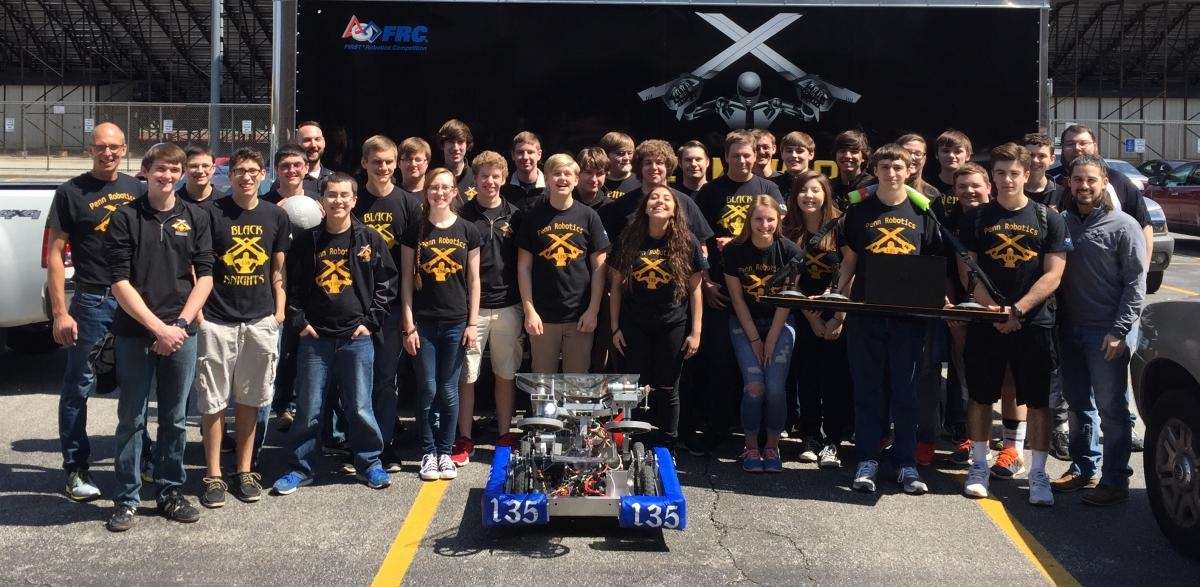
Penn High School’s Robotics Team 135 is competing in the state tournament in Kokomo this weekend.
Team 135 won the "Judges' Award" from the March 11-13 district tournament in West Lafayette, Ind, and "Engineering Inspiration Award" from the March 24-26 event in Indianapolis.
Augmented reality sandbox enhances student learning in Earth and Space Science class

Students of Penn High School’s Earth and Space Science class can put their hands in a sandbox and push the sand around to form various shapes.
But when Earth and Space Science class instructor Mark Watts turns on an augmented reality projector, colorful moraines, drumlins and kettle lakes spring to life. Snow appears on top of mountains formed out of the sand, and ripples wash across blue lakes.
Watts constructed an augmented reality sandbox that has students engaged in learning. Instead of struggling to visualize 3-D shapes from a flat map, the students are creating the 3-D shapes.
“It would be a lot harder to learn with just a 2-D map and a book, and it wouldn’t be as much fun,” Penn High School student Mitchell Spangler said. “On a map, it’s just flat. It’s a lot hard to visualize how it looks. With the augmented reality sandbox, it shows the topographic lines, but when we mold it, it shows how the different lines correspond with the different heights and the spacings.”
Watts’ wife, Penn World Languages Academy leader Kelley Watts, gets the assist for the engaging learning device.
“My wife found the information about the augmented reality sandbox on a Facebook page,” Watts said. “I contacted an instructor at the University of California-Davis, and he had a tutorial on how to set it up, and how to use the ‘Kinect’ camera from a PlayStation 3 for the video input, and then a regular projector for a computer. About the only thing it needs that is really special is a high-quality graphics card, because it actually simulates water and ripples and waves.”
In the augmented reality sandbox, colors contour to the elevation. The computer sees the sand in 3-D, and then a color-coded image is projected onto the top of the sand. As the sand shapes change, so does the color-coded map. Blue represents low areas, red represents high areas. White represents the highest elevations (snow on a mountain).
Students can demonstrate their learning from a two-dimensional map by showing it with the shapes they form in the sandbox.
“For common people, this would be an example of trying on clothes and seeing how they would be on your body type, your height, your width, your size and your weight, but you wouldn’t have to go on through all the hassle of trying on different types of clothes,” Watts said.
Watts put in about 40 hours constructing the device. It involved learning computer software and constructing a frame.
“That was not a small learning curve, but it wasn’t bad,” Watts said of learning computer code. “I really have to give credit to Oliver Kreylos at UC-Davis, who wrote the tutorial. It pretty much walked me though step-by-step.”
Spangler agreed with Watts that the augmented reality sandbox is a difference-maker in the classroom.
“The virtual reality sandbox gives us a visual on how topography affects different things, like movement of water, or other substances, such as lava,” Spangler said. “Other equipment can switch the settings to where the liquid falling off of the sand has the same viscosity as lava or even snow.
“It’s really helpful. It gives us a chance to use our hands to sculpt the environment and see how the rain might fall off of the slopes, or see how long it takes for snow to be permanent on top of a mountain. It allows us to experiment with the shapes of different features, because volcanoes can’t have a slope of more than 30 degrees, because they’re just sediment. We can find that out by pushing the sand together, and if it goes over a certain angle, then gravity will pull the loose sediments down. Because of that, it can only be at a low angle and still be stable.”
Watts said that he has many former students contact him about their learning experiences in Earth and Space Science class.
“One of the things that the kids who go into the armed services tell me is, ‘I thought we were done with that topographic map stuff, but the first thing we had to learn when we got into the service was how to read a topographical map.’ I grin and chuckle and say, ‘It is a good idea where you and everybody else are.’”
Watts said that the time he put into constructing the augmented reality sandbox has paid big dividends in the classroom.
“The students think it’s the coolest thing – for a good 10 minutes, I have their complete attention,” Watts laughed. “ If you’re trying to get a grade school or grammar school kid in earth and space science or geology, this would be just the thing to have them play around with.”
TECHNOVATION 2016 – Penn to host educators’ conference July 20 & 21
TECHNOVATION 2016—part of the IDOE’s Summer of eLearning conference series—is all about educators sharing what they have learned about using technology effectively in the classroom. 
The two-day conference (July 20 and 21) will be centered on the intentional placement and innovative practices of technology in the classroom. The conference will be held at Penn High School (56100 Bittersweet Road, Mishawaka IN). All sessions and workshops will be designed to benefit K-12 educators and those who support instructional technology in school districts across northcentral Indiana.
State Superintendent of Instruction Glenda Ritz will address conference attendees July 20, and Mr. George Couros will deliver the July 21 keynote address. Couros is the Division Principal for Parkland School Division, Canada, and an Innovative Teaching, Learning, and Leadership consultant. Couros also recently released the book The Innovator’s Mindset and he hosts the website The Principal of Change.
Penn-Harris-Madison is pleased to host this conference for the second time. Last year the school district participated in the Summer of eLearning by hosting the one-day Technovation “Road Trip.” Over 300 attendees, speakers, volunteers and vendor-partners participated in the 2015 conference.
Organizers anticipate that this year’s event will draw more than 400 people—all ready to share what they know about teaching and learning in the digital age!
WHAT TO EXPECT
July 20 – WORKSHOP DAY
- Day One will feature a keynote by Indiana State Superintendent Glenda Ritz, as well as half day workshops centered on use of technology in instruction. Lunch will be provided.
July 21 – CONCURRENT SESSIONS
- Day Two will feature a keynote by George Couros, author and leading educator in the areas of innovative leadership, teaching and learning. Also planned: Concurrent sessions and a chance to see what’s new in technology from our valued partners. Lunch will again be provided, as will opportunities to win door prizes!
►Find out more at the Technovation 2016 eLearning Conference Website
REGISTRATION IS NOW OPEN
Register now for general admission using the link below.
►Register online at Technovation 2016 Attendee Registration
After May 1, go back online to see the schedule of sessions and workshops and reserve seating for the ones you would like to attend.
CALL FOR PRESENTERS
The strength of a conference is built on the quality of its sessions! We will be offering multiple concurrent sessions (approx. 50 min.) and workshops (approx.120 min.) spanning teacher, leadership and tech director strands.
If you would like to present at TECHNOVATION 2016, click on the link below to propose a session. We are looking for topics that are relevant across the K-12 spectrum and can engage beginning, intermediate and advanced adult learners. (Know that if demand for a particular session is low, that session may be removed from the schedule.)
Please share this opportunity with anyone you know who might be interested in presenting at TECHNOVATION 2016.
►Session Proposal Google Form
Penn senior James Kempa earns honors at the state level
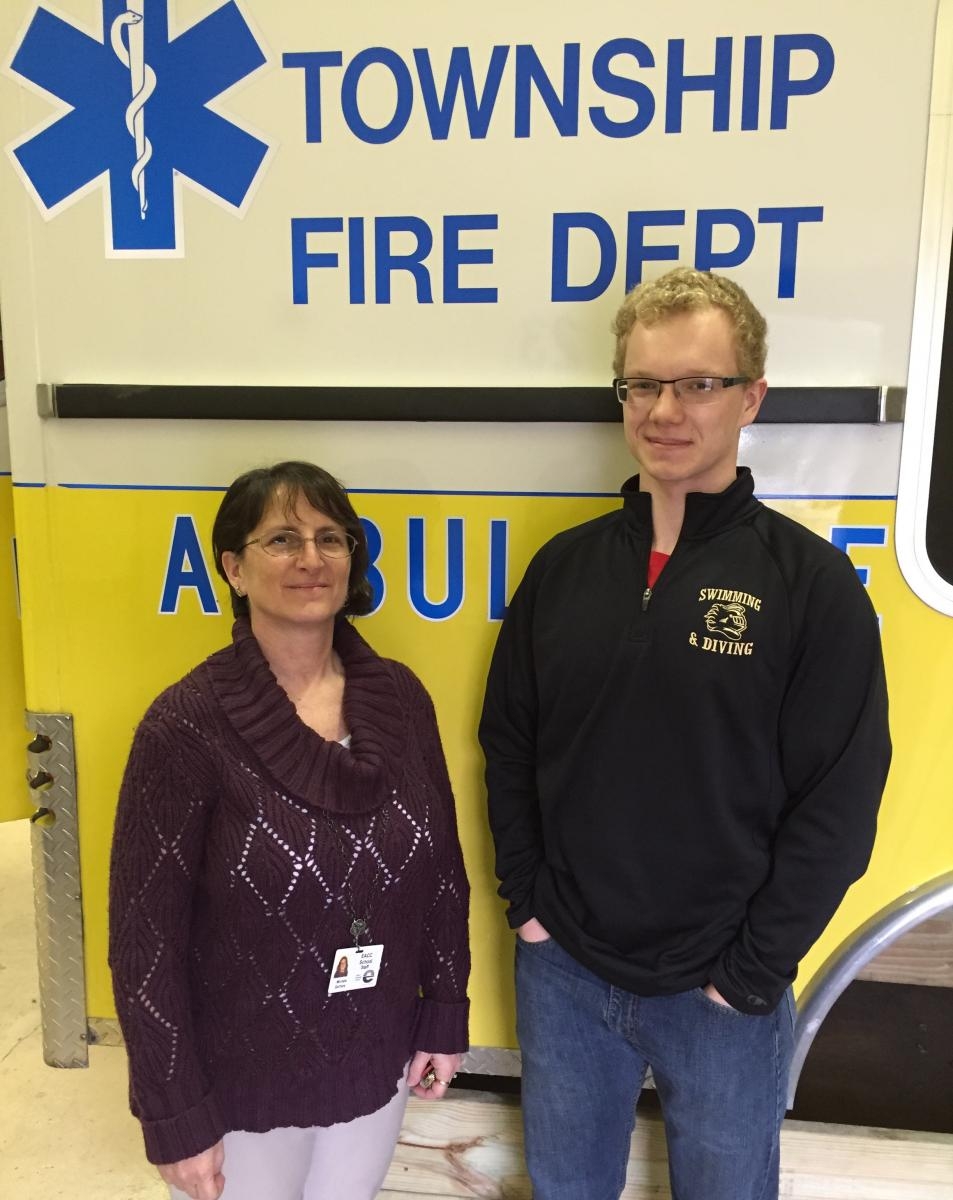
with the Indiana Career and Technical Education Award for Excellence. Kempa is pictured with EMT
program instructor Michelle Zachary at the Elkhart Area Career Center.
James Kempa, a Penn High School senior and member of the Health & Human Services Academy, is one of only 14 high school students statewide to be recognized with the Indiana Career and Technical Education Award for Excellence.
This award is presented in recognition of outstanding achievement in scholarship, citizenship, leadership, employability, and technical skill proficiency.
James was nominated by Michelle Zachary, Emergency Medical Technician program instructor at the Elkhart Area Career Center. He was evaluated on a portfolio of academic, service and leadership activities, along with letters of recommendation.
James accepted his award at a ceremony in Indianapolis on February 23, 2016. Glenda Ritz, Indiana’s Superintendent of Public Instruction, addressed the award winners at the event, congratulating them on their achievement.
“James is a very dedicated learner, and he is a born leader,” Zachary said of Kempa. “He helps the other students for the success of the whole group.”
Kempa said that he is grateful that Penn offers him an early start on his career path. Kempa plans to be an emergency-room doctor. He will study medicine at Calvin College.
“Actually getting to start the process in high school of learning emergency-room medicine, which is my ultimate goal, is great,” Kempa said. “The most important thing we’ve learned is medical assessment, asking the questions and assessing the vital signs, so you get an idea of what’s going on with your patient. We’ve had some lecture, and some of the class is skills practice. We do a lot of scenario work, and we’ve done clinicals on the ambulances and in emergency rooms in the area.
“This is great that Penn offers its students a resource like the Elkhart Area Career Center,” Kempa said. “It’s an awesome opportunity, and I’m thankful for it.”
Among James' other achievements:
- Earning EMT certification through the EACC program
- Attaining American Heart Association, American Red Cross, and FEMA certifications
- Earning 13.5 dual college credits through Ivy Tech Community College
- Qualifying for both Academic and Technical Honors diplomas
- Member of the National Honor Society
- Member of the National Technical Honor Society
- Achieved rank of Eagle Scout, BSA
- Lettering all 4 years in a sanctioned sport
- Served as 2015-16 captain of the Penn Boys' Swim Team
- Participating in the German American Partnership Program (GAPP)
James attended Horizon Elementary and Discovery Middle Schools before attending Penn. Following graduation, he plans to attend Calvin College (Grand Rapids, MI) where he will pursue pre-med studies and continue to swim. His goal is to become an emergency medicine physician.
“Own Your Future” is a credo that motivates many Penn students to do their best while in high school—even as they lay plans for future success. James is a great example of this!
Penn all-girls IED class meets Braylen
By KENNEDY PARKER
Penn High School Student Reporter
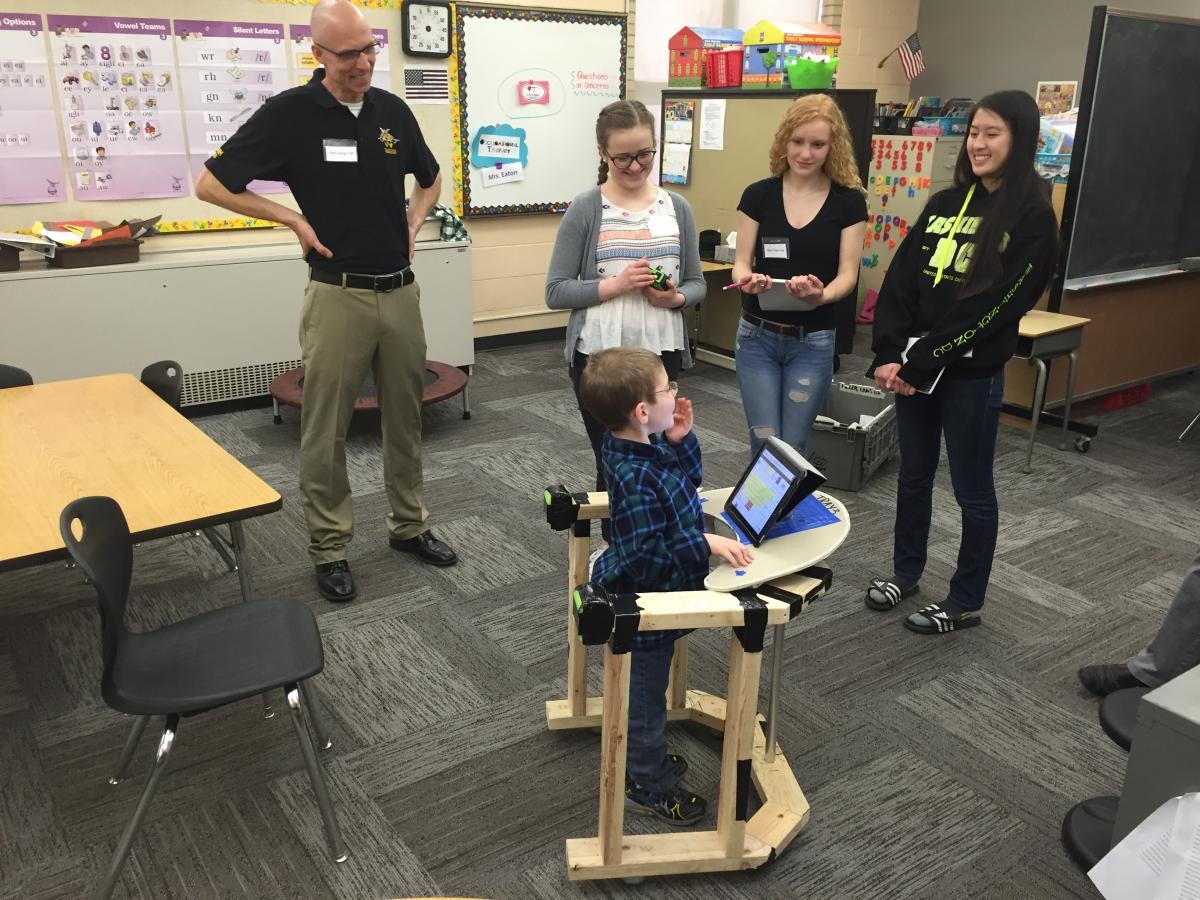
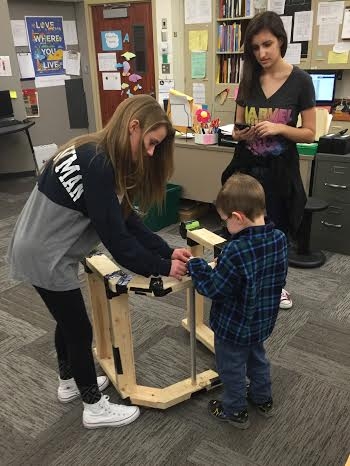
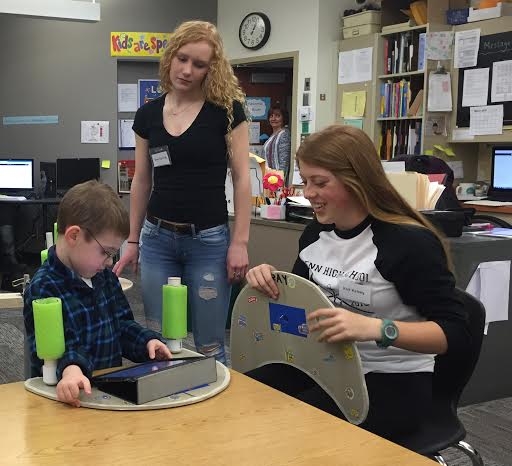
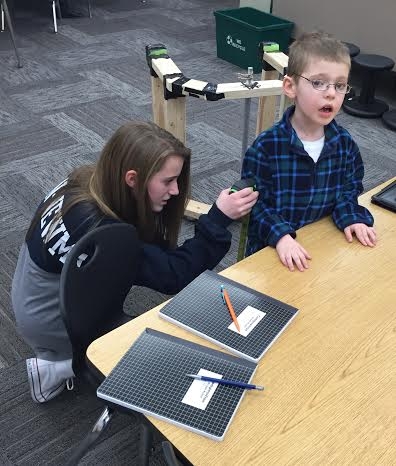
Penn’s all-girls Intro to Engineering Design (IED) class is continuing to work on a project to promote learning and helping others. The project, coined, “Voice for Braylen” is allowing the students to work together to solve a real-life problem. Click here to read part one of Braylen’s story.
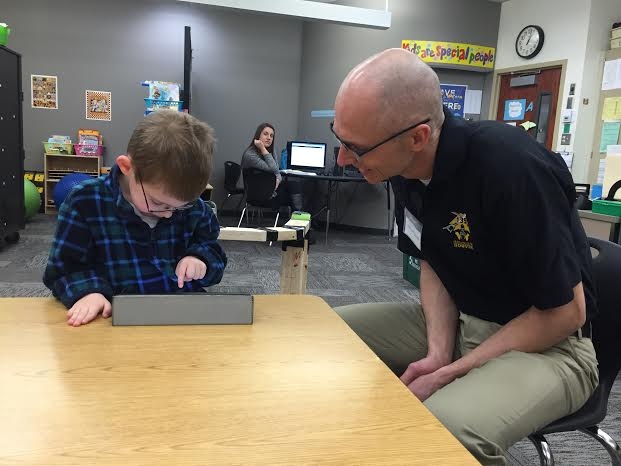
The project is centered around Braylen, a kindergarten student at Elsie Rogers Elementary School in the Penn-Harris-Madison school district. Braylen has been diagnosed with Joubert Syndrome, which affects his balance and coordination. Braylen is very intelligent, but unable to speak and is faced with mobility challenges. He will soon receive a new device to help him speak, called the Accent 800. This technology will allow Braylen to touch different pictures on the screen and the tablet will speak for him. Penn’s engineering class is designing and building a stand that will hold the device and make it mobile so that Braylen can easily take it with him during the school day.
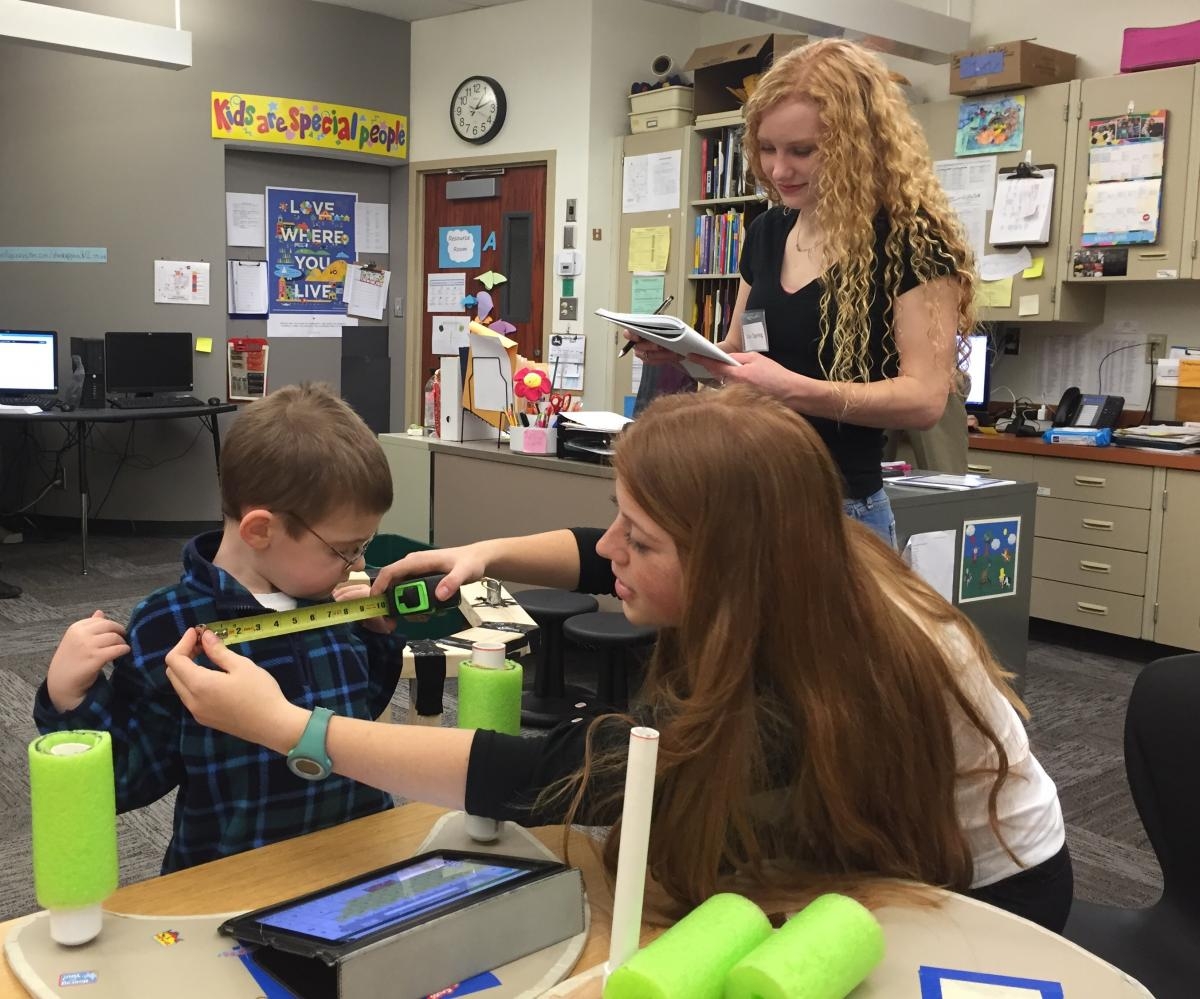
On Monday, March 21, the girls’ IED class traveled to Elsie Rogers to meet with Braylen. They tested out their first design, conferred with Braylen’s teacher, aides, and principal, and gathered measurements.
The students were able to see his school environment and learn more about new constraints for the structure. Braylen is really hoping that it can go outside so that he can communicate with his friends at recess. Ideally, the mobility device would be able to collapse or become smaller so that it can travel with him to and from school. Now, with this feedback, the engineering students are beginning to talk about ideas for their second mock-up.
While at Elsie Rogers, the girls split up into teams to take turns meeting with Braylen, Mr. Langfeldt, the principal at Elsie, and his aides. The teams that weren’t meeting with Braylen took time to work on STEM (Science Technology Engineering and Math) related activities with the other students in Braylen’s kindergarten class. The activities included building marble runs, making towers out of plastic cups, and building structures out of toothpicks and marshmallows.
The students are grateful for this opportunity to not only learn more about engineering and manufacturing, but to help out the community as well.
School for their meeting with Braylen.
Penn Biology teacher named finalist for Presidential Award

Penn High School Biology teacher John Gensic has been selected as a finalist for the Presidential Award for Excellence in Math and Science Teaching.
The Presidential Awards for Excellence in Mathematics and Science Teaching (PAEMST) are the nation's highest honors for teachers of mathematics and science (including computer science). Awardees serve as models for their colleagues, inspiration to their communities, and leaders in the improvement of mathematics and science education.
Mr. Gensic will be recognized with other honorees by the Indiana Department of Education at a luncheon Friday, April 15 in Indianapolis. The National Science Foundation convenes a national selection committee composed of prominent mathematicians, scientists, mathematics/science educators, district level personnel and classroom teachers that reviews the applications of the state finalists and recommends to NSF up to two finalists in mathematics or science from each state or jurisdiction. PAEMST winners are typically announced and honored the year following the receipt of the application. Each awardee receives a certificate signed by the President of the United States and a $10,000 award from NSF. Awardees and their guests are honored during events that take place in Washington, DC. These events include an award ceremony, celebratory receptions, professional development programs, and discussions with policy-makers on how to improve mathematics and science (including computer science) education. Since 1983, more than 4,400 teachers have been recognized for their contributions in the classroom and to their profession.
This past summer Gensic, was one of 15 educators chosen from more than 60 applicants, to work alongside scientists from the U.S. Environmental Protection Agency (EPA) on a research project on Lake Michigan. As part of the Lake Michigan Shipboard Science Workshop, Gensic and the scientists worked on onboard the research vessel Lake Guardian from July 12-18, 2015. Gensic and the other teachers evaluated the presence of microplastics and assessed the impact of aquatic invasive species—particularly zebra and quagga mussels—on Lake Michigan’s ecosystem. Samples were analyzed onboard the research vessel’s laboratories. You can read more about about Gensic’s research and experience by clicking here.
Senior ads for Yearbook can be designed and purchased now
Senior photos wanted for Yearbook
Seniors, if you have any photographs of yourself wearing college gear or displaying letters of acceptance from colleges or military academies, please share these with ebosworth80@phm.k12.in.us